
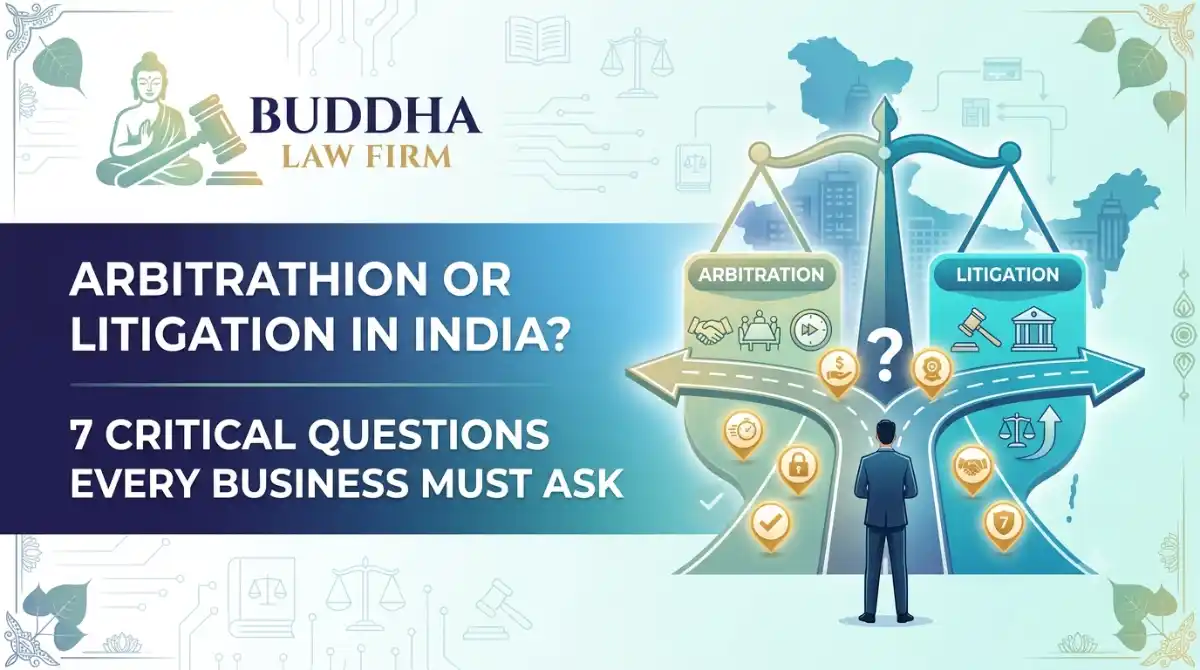
Businesses often have more than one possible dispute-resolution route. Where a valid arbitration agreement exists, the Arbitration and Conciliation Act, 1996 provides a statutory framework for arbitration. Litigation before courts may still be appropriate depending on the dispute, relief sought, parties and applicable law.
Arbitration or Litigation in India? 7 Critical Questions Every Business Must Ask
1. Is there a valid arbitration agreement?
The first question is contractual. Section 7 recognises an arbitration agreement when the statutory requirements are met. The contract, incorporated terms and correspondence should therefore be reviewed before assuming that a dispute must be arbitrated.
2. What relief is actually required?
The nature of the relief matters. A party may need urgent interim protection, preservation of evidence, injunction-related relief, recovery of money or a final adjudication. The available procedural routes should be assessed against the specific remedy required.
3. What happens if a suit is filed despite an arbitration clause?
Section 8 provides for reference to arbitration in specified circumstances when a judicial authority is seized of a matter covered by a valid arbitration agreement. The timing and supporting copy of the agreement are important.
4. How will evidence and witnesses be handled?
Both arbitration and litigation require a coherent evidentiary record. Contracts, invoices, emails, technical records, minutes and witness evidence should be preserved from the beginning.
5. What are the procedural implications?
Arbitration can offer a specialised private adjudicatory process, while court litigation follows the applicable civil and procedural framework. The contract may also specify an arbitral seat, institution or procedure.
6. How will the outcome be enforced?
An arbitral award is subject to the statutory framework governing challenge and enforcement. A court decree follows the relevant court process. Enforcement strategy should be considered when selecting the dispute route.
7. What does the contract say about costs and the arbitral seat?
Commercial contracts may contain provisions concerning the seat, venue, institution, number of arbitrators, governing law and allocation of costs. These clauses should be read together rather than in isolation.
Conclusion
First, examine the contract, the nature of the dispute, the relief you seek, the evidence you hold, and your enforcement strategy before you choose between arbitration and litigation. Second, assess how each forum impacts cost, speed, confidentiality, and finality for your specific dispute. Moreover, treat the dispute-resolution clause as an operational part of the commercial bargain that actively protects your business interests. Therefore, never dismiss the clause as mere boilerplate, but deliberately design it to manage risk and secure enforceability.
Primary Source: India Code — Arbitration and Conciliation Act, 1996.